Wednesday, March 16, 2011

Update - Nuclear News in Japan

Fukushima Daiichi Before the 9.0 earthquake and tsunami on 3/11/11.
Wow, seems there's more interest in nuclear energy among my friends than I had thought. I have gotten all sorts of links and references so I thought that instead of editing my post from yesterday, I'd just write another one today.

First of all, I'm sure the thing that most people care about right now is the situation at the Japanese power plant Fukushima Daiichi. Now, I try not to get too much into politics because that is an environment (pun haha!) that I don't think I could pull my weight in, but I realize that my blog will move into hot-topic territory now and again and I'm going to be forced to address these problems from a position that's more political.

I guess this means that I'm going to have to get some things straight so as not to confuse my audience. I am, if it weren't obvious already, far more liberal on a lot of issues, maybe even most issues, and certainly on issues concerning the health of people and the environment. However, I realize that overly "liberal" people are just as bad as the "conservative" people they oppose, so I will try to at least be open to both sides of the argument.
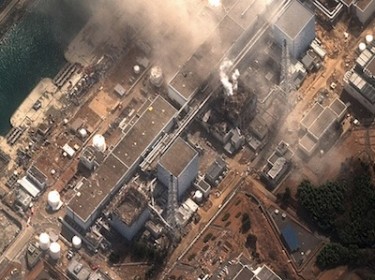
Damage to Fukushima Daiichi after the earthquake and tsunami on 3/11/11.


Ok so...Fukushima Daiichi.A lot of media sites seem to be blowing it out of proportion and there are all kinds of conflicting reports. From a practical standpoint, I want to say that the situation has gone a lot better than it could have for the power plant going through a 9.0 earthquake and a tsunami.

Here are a few articles that describe the nuclear situation as "better than it could've been":
1). http://tech.mit.edu/V131/N13/yost.html says:
"From the information we have, we can draw a conclusion anywhere between “the reactor is undamaged and being cooled” to “the reactor cladding and/or fuel has been partially damaged, but the damage is contained and the reactor is being cooled.” The question that should be asked now is whether the reactor has any future value as an electricity-producing asset. The widely-hyped possibility of some Chernobyl-like event is inconceivable without a new, catastrophic disaster. Coolant flow has been re-established and the public is in no danger. Given the magnitude of the precipitating event — a 9.0 earthquake — and the vast property damage it caused, the events at Fukushima are not a serious reason to re-evaluate our own nuclear policy in the United States."

An interesting thing I learned from this article is that the parts that blew off in the explosions in reactor 1 and 3 were the fourth "layer" of protection which was a drywall building not intended to actually contain anything. It seems like its job was to protect the workers from weather as they work around the containment vessel. So that means that the steel-and-concrete buildings could still be intact (the third layer of protection) and the steel container also (the second layer).


2). And http://www.theregister.co.uk/2011/03/14/fukushiima_analysis/page3.html:
"Radiation health effects have been pretty much zero. At times there have been heightened radiation levels inside the plants from short-life isotopes in the steam releases – sometimes enough that an unprotected person next to a reactor building might have sustained a year's normal dose from background radiation in an hour. This is not particularly terrifying, really – nobody is scared at the prospect of living another year on planet Earth – but it is being reported under scaremongering headlines. Another thing the weekend reporters have missed was the fact that all but tiny traces of the airborne radionuclides (from the salt in the seawater coolant) were disappearing before they could even cross the street; there is essentially no health hazard to people living nearby. Precautionary evacuations and tests were just that: precautionary."

3). The BBC is also saying about the same thing as these two articles above so at this point I'm still feeling confident in nuclear technology.


Reactor 1 after the explosion 3/12/11.

Tuesday, March 15, 2011

Powering Our World - Environmental Impact of Nuclear Power

Hi Guys!

Sorry it's taken me so long to post something, I'm currently taking a C++ class that is sucking up all of my time. However, this crisis in Japan has gotten me thinking about creating power and how that affects our environment. This is probably going to be very basic as I don't know much yet about the different types of power, but we've gotta start somewhere in talking about what we **know**.


So...The first form of power I wanted to look at is, of course, nuclear power. It seems there is a divide between whether it's safe or not and the impression I get is that it's a pretty big divide. Fun Fact: the US produces the most nuclear energy making up 19% of all its power output and has 140 nuclear power plants. Not surprising as we Americans are used to having the most of everything. ;-)  However, France produces most of it's electricity - 80% - with nuclear plants. Ouch.

Pro:
The pro-nuclear stance , argue that nuclear power produces a very low amount of air pollution that leads to greenhouse gasses or smog. That also makes it sustainable. Another pro argument is that the risks of storing waste are small and even smaller in light of new technologies in newer plants.

And, to be honest, nuclear safety is a trending pretty high on the positive with the only really big disaster being Chernobyl (so far). Though, if this power plant in Japan becomes a bigger disaster, I think that would be slightly different because they did suffer a 9.0 earthquake. I mean, c'mon...they also had oil refineries blowing up all over the place too. I don't think much would be safe from this type of threat. Though luckily, it's a rare occurrence.

Con:
The anti-nuclear view, conversely, asserts that nuclear power does pose serious human and environmental health risks. Transport, storage and disposal of nuclear waste is toxic and the contents can sometimes still be highly radioactive. Some argue that disposal of nuclear waste cannot be achieved 100% safely - with careless disposal polluting lakes, rivers, oceans and land. Lastly nuclear power plants are expensive to build which trickles down to make the energy actually rather expensive.

At this point, I am torn between supporting and condemning nuclear power. I mean, I have seen visible proof of what coal does (did) to buildings in Europe and older parts of America. I can't imagine putting all that black stuff out there wouldn't hurt the atmosphere so the prospect of nuclear power producing virtually no emissions, is attractive.

However, big accidents are just as bad, if not worse, as slow rates of pollution. You know...I can't really make a case against nuclear power right now. I just don't know enough and I can't really come up with a good alternative without doing more research.

Please weigh in with your thoughts. =)
 
I wanted to post a video talking about nuclear power but the only one I've found so far is a Fox News one and I just can't stand behind the quality of their broadcasting. So, if anyone knows of a good one, please let me know!

Wednesday, January 26, 2011

How the HECK do I recycle THAT?

Hiya!

With the holidays having come and gone, new-year cleaning/reorganizing has begun and with that I have come up with a lot of things made from plastic or toxic materials that I REAAAAALLY don't want to put in the landfill. So I have taken it upon myself to find out if there is any hope for keeping these things in the society and out of the earth. So...here is a list of some hard to recycle items and their (possible) solutions. And this is only a partial list b/c calling all these companies takes FOR-EV-ER!

I will be distinguishing between "recycle" and "reuse" here because they are very different in nature.  Recycling does take some resources but it also turns useless things like old computers into useful things like new computers. Reusing takes little to no earthly resources (fuel, electricity etc) and keeps the products in the world they way they are. However, there's only so many hanger-mobiles or CD-scarecrows you can have before you need to recycle THOSE too!


Recycle: literally "to cause to pass through a cycle again" according to dictionary.com. But it also means "to alter or adapt for new use without changing the essential form or nature of".

So, can you recycle...?
  • CDs/DVDs? YES! I used to work for the CU Engineering Center doing distance learning and I remember scratching CD after CD then putting them in a box to be shipped off to some big CD recycling place somewhere. So I was thinking...are those places still around? Because just this morning I noticed my gigantor CD binder filled w/ burned CDs many of which I'll probably never listen to again (thank you, Apple...) and thought "Gee...those guys are going to just sit in my house till I get tired of them but THEN where will they go?" The CD Recycling Center is just one place online I found that you can ship your CDs and cases to. Of course, this does cost money, in both the shipping costs as well as the $2.00 donation per shipment they ask to help keep their services free. But hey, $2 is better than $5 or $10 or $20 or $100 right?  So I still think it's a win! There's also a new program in which some bigger Best Buy stores are accepting CDs and DVDs w/o cases to recycle. I have a lot more info on this so check out my previous post: Holy Moly! It's Best Buy!
  •  Computers - Best Buy!
  • Metal Hangers?  - YES! My local recycling joint, Eco-Cycle, will take them in their scrap metal bin. 
  • Plastic Hangers (the cheapo kind from clothing stores)? (you know, the ones that say size S on the top?) - Maybe. I've heard that some supermarkets will but I can't find any in my area that do. But you can reuse them (I gave them to my mom for her belly dance stuff)!
  • VHSs - Best Buy!
  • Plastic Bottle Lids - If you read one of my earlier posts plastic lids, you'll find out that plastic is scary. I'm still not sure on this one, I did find Preserve Products which recycles #5 and 6 plastics and toothbrushes, but I'm not sure where lids fall on the number scale. But this company is cool b/c they make stuff back out of the plastic! Also, theoretically, Aveda used to do these, but I'm not sure of the status now, so give 'em a call to find out!


Reuse: While "recycle" means to adapt and change a product, "reuse" means "to use again" or basically "repurpose" a item without changing its form or its nature. 

Can you reuse...?
  • Air-filled Packing bags - YES! My place that takes the peanuts will also take the air-filled bags.
  • CDs  - YES! Coasters! But seriously...apparently they work great as "scare crows" in gardens that keep the birds away. We'll see...
  • Packing Peanuts/Plastic Loose Fill? - YES! Please see my previous post: These Peanuts Don't Make Good Butter.
  • Plastic hangers from clothing stores? (you know, the ones that say size S on the top?) - YES! Some thrift stores will take these like the Salvation Army but make sure to check first b/c if they don't use them, they'll just throw them away. You can also do crafts with these like baby mobiles and, if you're really talented, knitted hanger covers
  • VHSs - these guys are tough to deal with. The best thing to do is find out if places near you (schools, libraries, homeless shelters etc.) are not equipped with DVD equipment and you can donate them there. Or, you can crochet things from their tape. haha!
  • Plastic Bottle Lids: My cat shelter, the Rocky Mountain Siamese Rescue does take them to make cat toys out of and you can use them in all kinds of fun crafts. This probably merits its own post sometime in the future....


Here are some good resources to check out for hard to recycle items:
  1. How Can I Recycle This? Note: this is UK site so some info might be different, so research first!
  2. Eco-Cycle, Western Disposal, Waste Management (or your local recycling place website)
  3. Freecycle "The Freecycle Network™ is made up of 4,904 groups with 8,075,584 members across the globe. It's a grassroots and entirely nonprofit movement of people who are giving (and getting) stuff for free in their own towns and thus keeping good stuff out of landfills."
  4. The InterWebz - I know you're probably like...WTF? Of course I know this one, I'm reading your blog, aren't I? But that is where I got all of my info in this post. Oh yeah, and I called a f-load of stores. =)
*chokegasp* OMG....finally done! Enjoy! *shudder*

    Thursday, January 20, 2011

    Holy Moly! It's BEST BUY!


    While I was researching my "How Do You Recyle That?!" post I came across some awesome info that deserves its own post. Best Buy just started a new program called E-Cycle with the catch phrase "No matter where you bought it, we'll recycle it." Why haven't I heard of this sooner? Oh yeah...because I don't watch ANY TV and only listen to PBS kids when the kiddo's awake and I'm half-asleep.

    Here's the info for Colorado.
    What they take (from their website):
    • Three items per household per day.
    • Nearly everything electronic, including tube TVs and monitors up to 32", flat-panel TVs and monitors up to 60", peripherals, DVD players, home and car audio, cell phones, MP3 players, and cables.
    • Desktop or laptop computers with the hard drive removed. See this Geek Squad video for Do-it-Yourself instructions, or they will remove it for $9.99.
    • Small electrics, fans and vacuums.
    • They charge $10 for televisions and monitors, but you immediately receive a $10 Best Buy gift card good toward future purchase.
    • $10 fee does not apply to any Insignia®, Dynex® or VPR Matrix® products. Best Buy accepts these brands free of any charge.
    • The bubbly sales-girl on the phone also told me that they take VHSs and Floppy Discs too but that wasn't on their website so check first.
    What they don't take:
    • Internal and External computer hard drives.
    • Console TVs of any size, or tube TVs and monitors larger than 32". Use their  haul-away or pickup programs for these items.**
    • Electronics containing refrigerants, such as mini refrigerators or air conditioners. Please contact your local waste disposal department.
    • Appliances. Use our haul-away or pickup programs for refrigerators, freezers, dishwashers, washers and dryers, ranges and microwaves. **

    This is in addition to the stuff they already took which was inkjet cartridges, rechargeable batteries, CDs/DVDs, and gift cards. How cool is that? Mega cool, I say. 

    **The fact that they have haul-away and pickup programs is great to!

    Monday, January 10, 2011

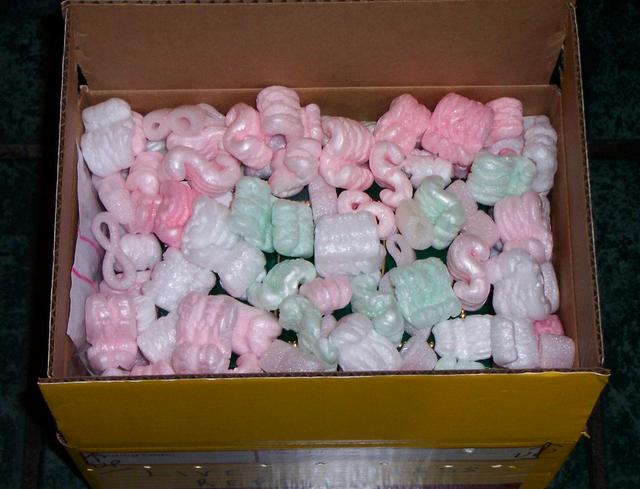
    These Peanuts Don't Make Good Butter

    It's Christmastime, you get a package in the mail. Who's it from? Grandma? You can't stand the excitement as you jam scissors into the tape. Maybe your 3 year old helps and gleefully rips the box apart. Suddenly...an EXPLOSION! Your excitement for the gift momentarily flags as you look around your littered living room.
    OH NO! PACKING PEANUTS! 

    The bane of package-openers everywhere!  Oh sure, kids and cats and static cling love them but the rest of the world, you think, would be better off without them. You resign yourself to cleaning up the mess, carefully pulling your gifts out so as not to anger the peanuts. Finally success presents itself to you and now you have a shiny new whatever from Aunt Fannie as well as a giant box of pink and green Styrofoam balls of death.  How thoughtful.... Packing peanuts- 1, you - 0.

    But never fear! For there is a solution in hand! In fact, this solution has been around for almost 2 decades but it seems not many people know of it.  RECYCLE the peanuts! The Plastic Loose Fill Council has been working since 1991 to "develop, promote and implement the original use and subsequent recovery, reuse and recycling of polystyrene loose fill, commonly known as "packing peanuts."" Who knew? They arrange drop-off sites as well as operate a hotline to deal with these little buggers. So check for a location near you and maybe next time, packing peanuts won't be so scary! (Still...keep the cat away from them. If you've never had to remove packing peanuts from a cat's fur, you've lived a privileged life).

    Here are some locations in the Denver-Boulder area:

    CENTENNIAL CONTAINER, INC.
    13105 EAST 38TH AVE, UNIT 58
    NEAR 1-70 AND PEORIA STREET
    DENVER, CO  80239-3551
    (303) 371-7700

    I SOLD IT ON E BAY CO.
    7506 EAST 36TH AVE, UNIT 450
    SHOPPING CENTER
    DENVER, CO  80238-3444
    (303) 539-6915

    Pak Mail
    2075 S. University Blvd.
    Denver, CO  80210-4300
    (303) 744-6245

    PostNet
    1312 17th Street
    Denver, CO  80202
    (303) 595-0500

    PostNet
    200 Quebec St. Bldg. 300, Suite 111
    Denver, CO  80230
    (303) 340-0998

    THE UPS STORE
    1685 SOUTH COLORADO BLVD, UNIT S
    COLORADO BLVD & MEXICO AVE
    DENVER, CO  80222-4040
    (303) 753-0888

    Pak Mail
    2525 Arapahoe Ave., #E4
    Boulder, CO  80302-6720
    (303) 444-0831


    AIM MAIL CENTER
    2205 W. 136TH AVE, STE 106
    KING SOOPERS CENTER ON 136TH & ZUNI ST
    BROOMFIELD, CO  80023
    (303) 280-6245

    THE UPS STORE
    1685 SOUTH COLORADO BLVD, UNIT S
    COLORADO BLVD & MEXICO AVE
    DENVER, CO  80222-4040
    (303) 753-0888


    Lucky #7 - 7 things to reuse, 7 things to avoid

    I just found this site called Greenopolis and while I haven't explored it fully, I found two fun and useful articles for the time being.

    #1:

    The Magnificent Seven: 7 Top Materials To Use And Recycle!


    For millennia we used leather, wood, clay, and stones along with animal and vegetable materials for nearly everything. When we threw something “away”, it went away- really back into the natural systems it came from.

    But 7 billion of us can’t rely strictly on grown materials, and most of our modern materials don’t go away very easily. Does that mean we should not use them? Not at all. We just need to get as smart as Ma Nature and learn to reuse and recycle those materials again and again. These Top 7 materials are safe, recyclable and just work really well for so many things. They include 2 metals, 3 plastics, and 2 natural materials. Here’s my list:
    1. Steel. Steel is probably the most recycled material on earth- about 70 % of all steel is recycled and nearly all the steel you use has recycled steel in it. Works great because of its strength and malleability. I’m a big fan of steel roofs, among other things.

    2. Aluminum. Abundant in nature, strong but lighter than steel, and it doesn’t rust. Aluminum is what caps the Washington Monument because it was once so prized. But mining and smelting aluminum is very energy intensive and polluting. That’s why recycling it is so important. Right now about 50% is recycled- we need to get that up into the 90% range like gold.

    MORE...

    What I want to know about this article is how it mentions recycling bottle lids. If anyone knows how to do that or can point me in the right direction, I'd be grateful! Sometime soon I will research this myself.


    #2


    7 Deadly Sins: 7 Materials To Avoid

    In the Church Of Green Living, some sins are more deadly than others.


    Little sins like forgetting to recycle paper can be overlooked, unless you are a newspaper publisher. But some are to be avoided at all costs. Here’s a list of 7 substances that cause real problems in the environment, and that we can avoid by taking a few simple steps in our lives.


    1. 2Polyvinyl Chloride, aka PVC, aka Vinyl aka #3 plastic. We’ve all got some vinyl in our houses, on furniture clothing, plumbing pipes- it’s the third most common plastic. But it usually has bad stuff that can leach out of it, like diethylhexyl phthalate, which is banned in Europe, vinyl chloride and dioxins.  The U.S. Green Building Council states that the "risk of dioxin emissions puts PVC consistently among the worst materials for human health impacts”.  You probably don’t have to strip off your vinyl siding, but avoid toys (including sex toys) with PVC. You don’t want it in or near you or your kid’s body.
    2. 2Polystyrene, aka Styrofoam, aka #6 plastic. Polystyrene is not easily recycled because of its light weight (especially if foamed) and its low scrap value. Discarded polystyrene does not biodegrade for hundreds of years. Commonly used in coffee cups and clamshells for food, it contains benzene, a known carcinogen, and while the FDA claims it is safe, there are studies concerning polystyrene containers used for food packaging which find that styrene oligomers migrate into the food and may increase thyroid hormone levels. It’s your call if you want your hot coffee or entrĂ©e served up in polystyrene. I avoid it.
    MORE...

    In this article it's these first two that bother me the most.  Partially for their poisoning rap but also (and, let's face it, MOSTLY) for the fact that I'm so good about not throwing away all kinds of other stuff, including stuff that breaks down faster (food --> composting) but I still get styrofoam take out containers and plastic crap off of the kid's toys. I think my next big goal is going to be to figure out how to cut back on using these items. NO STYROFOAM! grrrr....

    Wednesday, December 22, 2010

    Green Car Report

    In the market for a new car? Here's a site that tells you all about eco-friendly cars. The Green Car Report talks about specific cars that are better for the environment and all the components of driving more green!

    Here's a sample article:

    Ding-Ding-Ding! Electric Cars Likely To Be Made Noisier By Law

    December 20th, 2010

    In one particularly hilarious scene in the TV show Weeds, Mary-Louise Parker’s soccer mom/drug dealer character inspires a scary drug lord to buy several Toyota Priuses after he successfully carries out a drive-by shooting while riding in hers.  The selling point? The quietness of the hybrid. “Good for sneaking up on mother******s,” he cackles. 

    That might no longer be the case with a piece of legislation that recently passed the Senate and looks to be cleared for approval in the House. The Pedestrian Safety Enhancement Act would require electric cars and hybrids to make noise, and would fund the Department of Transportation to create a set of rules for automakers, who would be allowed some leeway in how they carry out the guidelines. Green cars like the Prius don’t make noise when running off their batteries. Whether you have an armed drug dealer as an enemy or (more likely) happen to cross the street without looking, hybrids are more likely to hit you than regular cars, especially when operating at low speeds when gas engines aren’t engaged, according to a study by the National Highway Traffic Safety Administration. All-electric vehicles like the 2011 Nissan Leaf could be even more of a threat. Of particular concern was the potential danger to blind pedestrians. But researchers and writers have also challenged that study, saying the methodology was flawed. Read More....